
Discipline 05
Designing businesses using agentic labor.
Most companies treat an AI assistant like a search box. The working model is a team: one coordinator, named specialists, a shared computer, and a hard approval boundary. We train you to build that system around the business you already run.
What this is
A coach-first training program. Not a product, not a platform — a way of running your company.
AI only works when it knows exactly what to do, what not to touch, and when to hand things back to you. A single catch-all assistant just turns into noise.
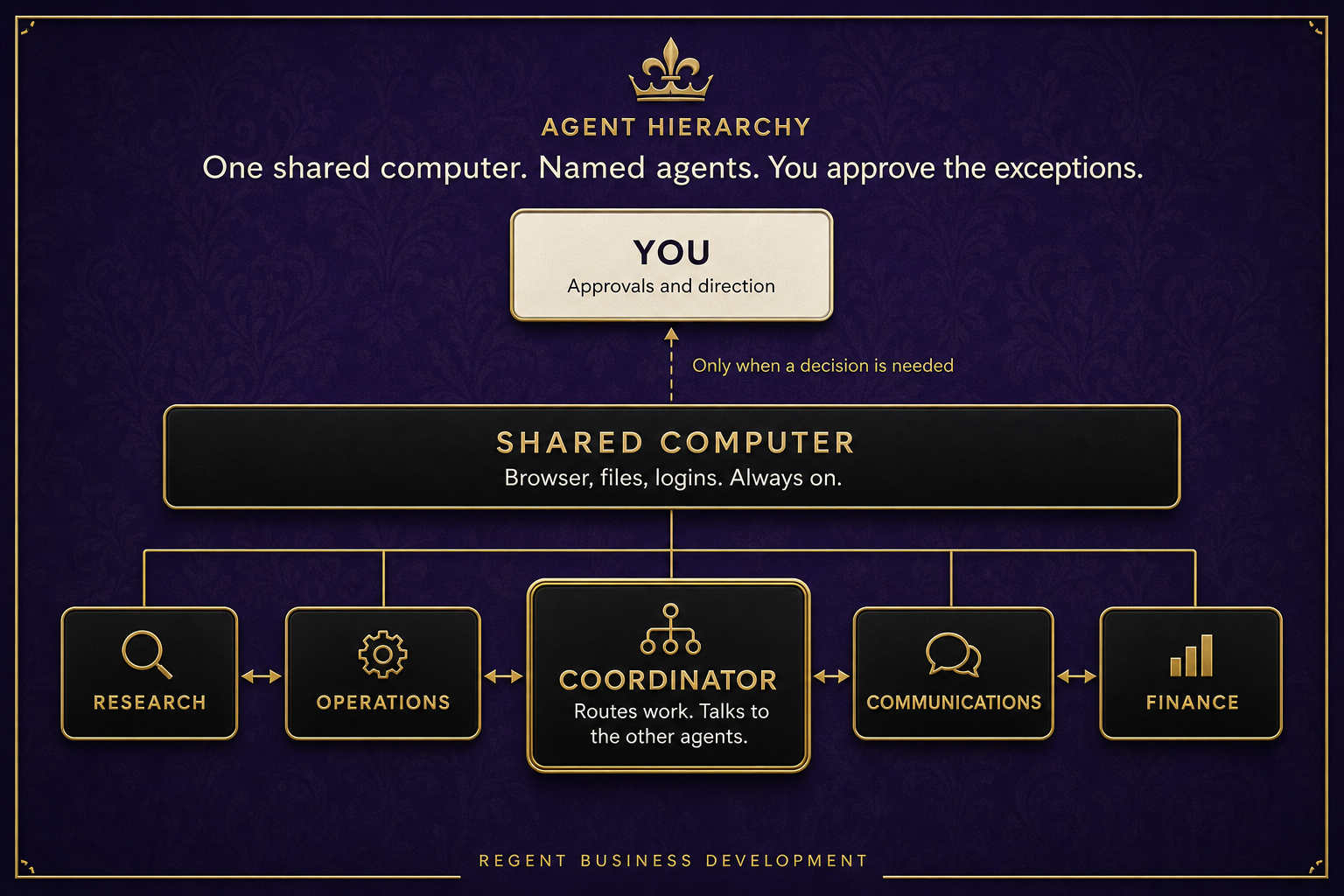
So we build you a real system: one coordinator routing the work, specialist agents each owning their lane, and a shared computer where they actually log into your tools.
You name every agent. You write their playbook. You decide what they can handle solo and what needs your eyes first. Then we run live work together until it feels natural. We may train using a coordinator like Grok Bot — but you're not buying a bot. You're learning to run the system.
By the end, you don't own a chatbot. You own a working team of agents, and you know how to lead it.
What you leave with
- A mapped hierarchy for your business — who reports to whom, and what each agent owns
- Named agents with written instructions, in your voice and your boundaries
- A working coordinator routine you run every morning without thinking about it
- Live coaching sessions where we run the system together on your real work
Why grind when you can delegate.
The founder doing every job
You're the strategist, the bookkeeper, and the inbox. Direction never happens because the hands are always full.
The small team that keeps colliding
Two people touch the same task, nobody owns the lane, and the work gets done twice or not at all.
The operator who wants overnight movement
You want the business to keep moving at 2am and across time zones, without hiring a night shift.
The one who tried and got mush
You handed everything to one generalist helper and got vague, unusable output. That's a hierarchy problem, not a talent problem.
Named agents. Clear lanes.
A system only works when everyone knows their lane. Here's the shape we build with you.
Coordinator
One coordinator. One point of entry.
Your intent goes to the coordinator, and the coordinator decides who carries it. It briefs the right specialist, tracks the work, and reports back to you. Nothing leaves the system without passing here first, which is why it never surprises you.
Finance
Money, invoices, and the ledger.
Quotes, invoices, receipts, follow-ups on what's owed. It drafts and prepares. You sign. Money never moves on its own authority.
Operations
Scheduling, files, and the daily order.
Keeps calendars honest, documents where they belong, and the standing routines running on time. The quiet work that decides whether a week feels calm or frantic.
Communications
Inbox, outreach, and the voice.
Drafts replies, prepares outreach, and holds your tone across every message. It writes in your register, then waits for your approval before a word goes out.
Isolated workspaces
One chat per person. One chat per company.
Every person and every company keeps its own workspace, with its own memory and its own context. One client's business never bleeds into another's, and no agent gets confused about whose work it is doing.
Routines
Scheduled work that holds while you're away.
Agents keep working through travel, family time, and sleep, within boundaries you set. What they may decide alone, and what waits for you, is written down before it ever runs.
You approve the exceptions.
A system with no rules isn't help. It's a liability. These are non-negotiable.
- Confirm whose account you're in before a single action is taken
- Nothing sends without approval — no email, no invoice, no money. Agents draft. You sign.
- Keep your daily tools signed in so agents can work without asking
- Start with the tools you already touch every day, then add more from there
- One lane per agent — when work collides, the hierarchy is wrong, not the agent
- Review the output weekly the same way you'd review a hire
Ready when you are
Stop working every job. Start running the system.
A 30-minute discovery call is usually all it takes to see what your hierarchy should look like, and which agent you'd name first.
Book a call